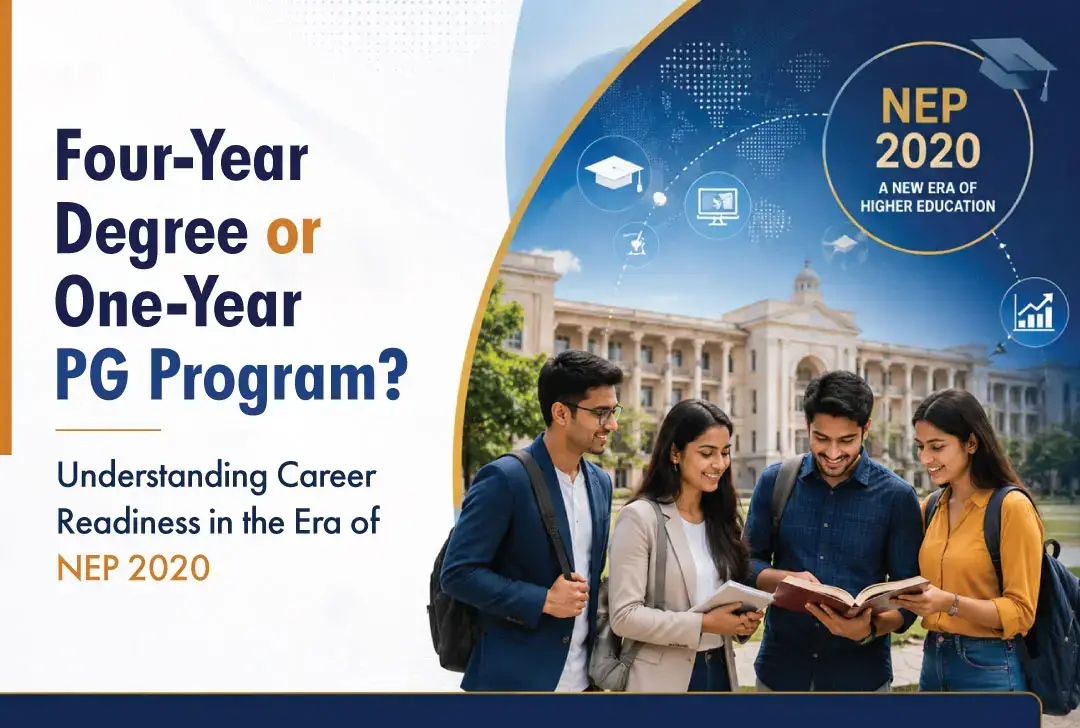


The introduction of the National Education Policy (NEP) 2020 has significantly reshaped higher education in India. The policy encourages flexibility, multidisciplinary learning, experiential education, and stronger industry alignment. As industries evolve rapidly, students are increasingly questioning traditional academic pathways and exploring programs that offer faster career readiness.
In fields such as journalism, digital media, advertising, public relations, corporate communication, and content creation, one important question continues to emerge:
Should students pursue a traditional four-year undergraduate degree or opt for a one-year postgraduate skill-based program that offers faster industry exposure and employability?
The answer depends on career goals, learning preferences, and the kind of professional journey students envision for themselves.
How NEP 2020 Is Changing Higher Education
NEP 2020 has shifted the focus of education from rote learning to skill development, critical thinking, flexibility, and interdisciplinary education. Today’s employers are not only looking for academic qualifications but also practical capabilities, digital fluency, creativity, communication skills, and adaptability.
This shift is especially visible in the media and communication industry, where technology, platforms, and audience behavior are evolving continuously. As a result, students are now evaluating educational programs not only based on academic reputation but also on employability and industry readiness.
Why a Four-Year Degree Still Matters
A four-year undergraduate degree continues to offer several long-term advantages for students.
One of its biggest strengths is academic depth. Students gain a broader understanding of subjects such as communication theories, sociology, psychology, economics, political science, media ethics, research methodologies, and cultural studies. This intellectual foundation helps students understand the larger social and cultural role of media.
The extended duration also allows students to grow gradually. Many students begin college without complete clarity about their interests. Over time, they explore different disciplines, participate in extracurricular activities, contribute to student publications, attend workshops, and complete internships. This environment supports both personal and professional development.
Benefits of a Four-Year Degree
- Strong academic and theoretical foundation
- Multidisciplinary learning opportunities
- Better exposure to research and critical thinking
- More time for internships and extracurricular activities
- Preparation for higher education and international studies
- Gradual personality and confidence development
NEP 2020 strongly promotes interdisciplinary learning, and four-year programs are well suited for this model. Students can combine journalism with business studies, psychology, digital marketing, data analytics, design, or public policy, creating more adaptable professionals.
However, one common criticism of traditional degree programs is limited industry integration. In many institutions, learning remains theory-heavy, while practical exposure to digital storytelling, multimedia production, SEO, analytics, content strategy, and AI-driven communication remains insufficient.
Why One-Year PG Programs Are Gaining Popularity
One-year postgraduate diploma and certificate programs in Mass Communication, Journalism, Advertising, Public Relations, Corporate Communication, Digital Media, and Event Management are becoming increasingly popular among students seeking faster career entry.
These programs are designed to be industry-oriented and skill-focused. Instead of emphasizing only theoretical concepts, they focus on practical learning through newsroom simulations, multimedia storytelling, podcasting, studio production, campaign planning, digital marketing, social media strategy, branding exercises, and field reporting.
Students actively work on projects that mirror real-world media environments.
Key Advantages of One-Year PG Programs
- Faster entry into the workforce
- Practical and hands-on training
- Industry-focused curriculum
- Exposure to digital and AI-driven media trends
- Portfolio and internship opportunities
- Stronger professional networking
Today’s media industry increasingly demands professionals who can create multi-platform content, analyze audience engagement, manage digital campaigns, and adapt to changing technologies. Skill-based programs are designed to address these evolving expectations.
Another major advantage is industry exposure. Institutes like Apeejay Institute of Mass Communication (AIMC) invite journalists, editors, advertising professionals, digital creators, and communication experts for workshops, guest lectures, and mentorship sessions. Such interactions help students understand professional expectations while building valuable networks.
Modern communication programs also update their curriculum regularly to include emerging areas such as:
- Digital Journalism
- Influencer Communication
- AI in Media
- SEO and Content Strategy
- Data Journalism
- Multimedia Production
- Strategic Communication
- Social Media Analytics
Importantly, strong PG programs do not ignore theory altogether. They integrate communication theories, media ethics, audience behavior, and media research with practical application and experiential learning.
Four-Year Degree vs One-Year PG Program: Which Is Better?
There is no universal answer. The right choice depends entirely on the student’s career goals, financial situation, interests, and learning style.
A Four-Year Degree May Be Better for Students Who:
- Want broader academic exposure
- Prefer multidisciplinary learning
- Are still exploring career interests
- Plan to pursue research or higher education
- Want a complete campus experience
- Prefer gradual professional development
For such students, a four-year degree builds a strong intellectual and academic foundation that supports long-term flexibility.
A One-Year PG Program May Be Better for Students Who:
- Already hold a bachelor’s degree
- Want faster employability
- Prefer practical learning environments
- Seek industry-oriented training
- Want to build portfolios quickly
- Aim for careers in journalism, advertising, PR, digital media, or corporate communication
For these learners, a one-year postgraduate program can provide accelerated professional growth and immediate career readiness.
The Growing Demand for Industry-Ready Communication Professionals
The media and communication landscape is changing rapidly. The rise of digital journalism, creator-driven platforms, AI-powered content tools, and social media marketing has transformed the skills required in the industry.
Today, employers are increasingly hiring professionals who can:
- Create digital-first content
- Work across multiple media platforms
- Use analytics and audience insights
- Understand branding and strategic messaging
- Adapt to AI-enabled communication environments
- Communicate effectively in fast-changing situations
This is why career-focused Mass Communication and Digital Media programs are gaining relevance in the post-NEP education landscape.
NEP 2020 Promotes Flexibility, Not Hierarchy
One of the most important aspects of NEP 2020 is its emphasis on flexibility. The policy recognizes that there is no single pathway to success.
Students no longer need to choose between academic learning and skill-based education as if they are opposites. A learner may pursue a multidisciplinary undergraduate degree and later specialize through a one-year professional program. Another student may begin with industry-focused education and continue learning through certifications and advanced studies later.
This flexible approach reflects the realities of today’s workforce, especially in media and communication industries where continuous learning has become essential.
Final Thoughts
The debate between a four-year degree and a one-year postgraduate skill-based program should not be viewed as a competition between theory and practice. Both pathways serve different educational and professional goals.
A four-year degree offers intellectual depth, multidisciplinary exposure, and long-term academic development. A one-year PG program provides specialized training, practical experience, industry exposure, and faster employability.
In the evolving world of media and communication, the most successful professionals will be those who combine academic understanding with practical digital skills, creativity, adaptability, and continuous learning. Institutions that successfully integrate industry exposure, experiential learning, and academic rigor are likely to produce graduates who are not only knowledgeable but truly future-ready.