
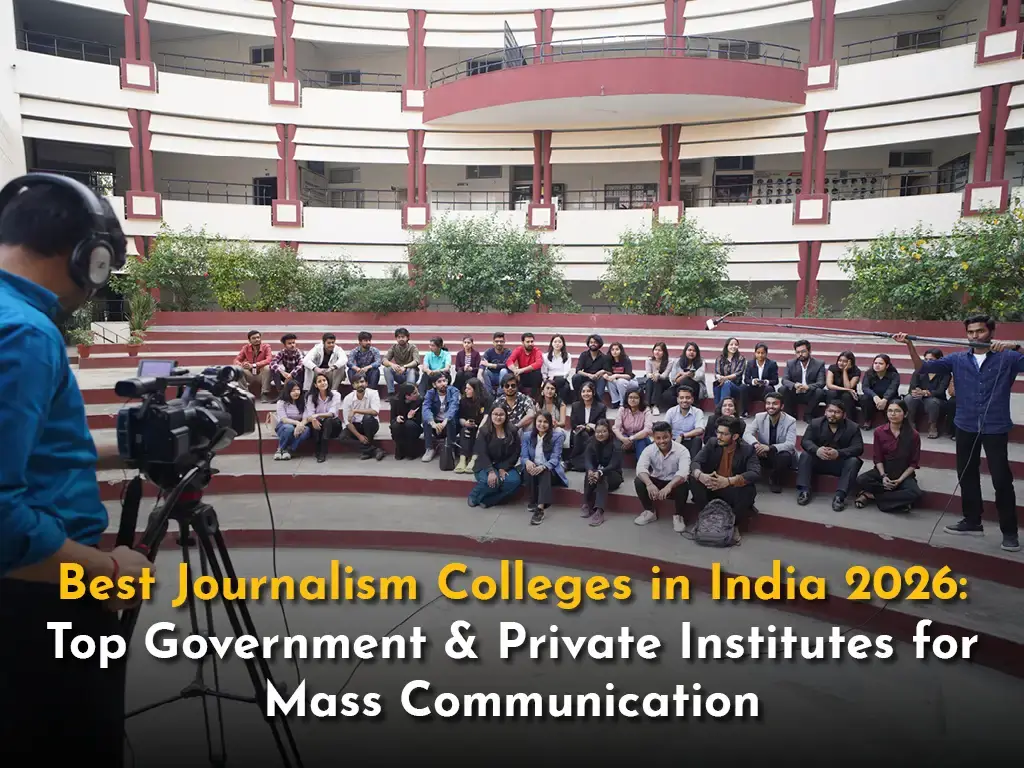


India’s media and entertainment industry is growing fast, but not in the old, predictable way. Journalism students today are no longer preparing only for newspapers, television, or radio. Many will work in digital newsrooms, OTT teams, production houses, public relations firms, branded content divisions, or social media-led news platforms.
Still, one decision continues to matter more than most: the college they choose.
A good journalism and mass communication institute does more than teach reporting theory. It gives students access to studios, editing labs, newsrooms, internships, teachers with industry experience, and a peer group that often becomes part of their professional circle. This handbook looks at some of the best journalism colleges in India in 2026. These cover private and government institutes, their rankings, placement, courses, and fee structure.
What Makes a Journalism College Truly Great in 2026?
Before you look at the list, it is worth saying how these colleges have been looked at. A journalism or mass communication college cannot be judged only by its name. A famous campus helps, but students also need places where they can report, edit, record, shoot, write, present, and make mistakes before they enter the industry.
The colleges in this list have been considered on these points:
- Specialisations: Some colleges offer a general media course. Others let students move into broadcast journalism, digital media, advertising, public relations, business journalism, or production. This difference matters.
- Facilities/Infrastructure: Media cannot be taught only through lectures. A great campus needs working studios, editing labs, audio rooms, newsroom-type spaces and enough equipment for students to get practice.
- Rankings: We have referred to the surveys by India Today MDRA, The Week Hansa, Outlook and EducationWorld.
- Recognition by AICTE/UGC: UGC recognition is important for degrees from universities. In some cases, depending on the nature of the programme, AICTE approval may be required. This recognition is important for higher studies, government applications, and employer confidence.
- Placements and internships: A good college should be able to show where its students intern and where they get placed. The names of visiting companies, the kind of roles offered, and the usual salary range say more than a glossy brochure.
- Faculty background: It helps when teachers have actually worked in newsrooms, studios, agencies, PR firms, or digital teams.
- Degree options: Credit transfer, lateral entry or recognised upgrade options with clearly defined pathways in the colleges are more reliable choices over time.
Keeping these points in mind, here are the journalism and mass communication colleges in India that are a class apart for 2026 and 2027.
Top Journalism Colleges in India at a Glance
| College | Type | Best For | Approx Fees |
| IIMC | Government | Print & Broadcast Journalism | ₹1.5–2 Lakh |
| AIMC | Private | Digital Media, PR, Advertising | ₹1.5–2.5 Lakh |
| SIMC | Private | Media Management | ₹8–10 Lakh |
| XIC | Private | Journalism & Advertising | ₹1.5–3 Lakh |
| AJK MCRC | Government | Documentary & Broadcast | ₹60K–1 Lakh |
| ACJ | Autonomous | Editorial Journalism | ₹3.5–5 Lakh |
Best Government Journalism Colleges in India
Government institutes continue to be the gold standard for postgraduate journalism education in India – largely because of their subsidised fees, ministry-backed credibility and deep ties with national media organisations.
1. Indian Institute of Mass Communication (IIMC), New Delhi
- Type: Government (Ministry of Information & Broadcasting)
- Established: 1965
- Location: Aruna Asaf Ali Marg, New Delhi (+ 5 regional campuses)
- Courses: PG Diplomas in English Journalism, Hindi Journalism, Odia Journalism, Radio & TV Journalism, Advertising & PR
- Fees: ₹1.5 – 2 lakh (entire programme)
- Entrance: IIMC Entrance Test
- Placement highlights: Major national newspapers, TV news channels, government media bodies, international wire services
- Notable alumni: Several senior editors and journalists at leading Indian and global media organisations
IIMC is India’s most prestigious government-run body for journalism education and is generally considered the most prestigious institution for postgraduate media training. Established in 1965 under the Ministry of Information & Broadcasting, it has campuses in Delhi, Dhenkanal, Aizawl, Amravati, Jammu and Kottayam, serving regional media ecosystems.
What makes IIMC exceptional is its direct pipeline to national and international newsrooms. Graduates consistently find positions in organisations like Doordarshan, All India Radio, The Hindu, Hindustan Times, ANI, PTI, NDTV, and BBC. Government subsidies keep fees dramatically low — making it the highest-return journalism investment in the country.
2. AJK Mass Communication Research Centre, Jamia Millia Islamia, New Delhi
- Type: Government (Central University)
- Established: 1982
- Location: New Delhi
- Courses: PG Diplomas in Print Journalism, Broadcast Journalism, Advertising & PR, Documentary Filmmaking
- Fees: ₹60,000 – 1 lakh per year
- Entrance: Jamia Millia Islamia Entrance Exam
- Notable alumni: Some of the notable names are Kabir Khan, Kiran Rao, Barkha Dutt, Roshan Abbas.
Jamia Millia Islamia’s AJK MCRC is one of the oldest and most respected journalism schools in India. Its strength lies in its research-driven training in journalism, a strong ethics curriculum and documentary filmmaking, a rarity among Indian media institutes. It has trained some of the country’s most respected journalists and documentary makers.
3. Asian College of Journalism (ACJ), Chennai
- Type: Autonomous (Partnered with The Hindu Group)
- Established: 1994
- Location: Chennai, Tamil Nadu
- Courses: PG Diploma in Journalism (Print, Broadcast, Online), TV Journalism
- Fees: ₹3.5 – 5 lakh (full programme)
- Entrance: ACJ Entrance Test + Interview
The institute occupies a unique position. It is technically independent but has the credibility of The Hindu Group behind it. Its curriculum is heavily influenced by working journalists and editors, and its location in Chennai offers strong access to South Indian media networks. The institute has an impressive track record of placing graduates in leading national newspapers, digital publications, and broadcast channels.
4. Makhanlal Chaturvedi National University of Journalism and Communication (MCU), Bhopal
- Type: Government (State University)
- Location: Bhopal, Madhya Pradesh
- Courses: BA, MA, PG Diploma in Journalism, Advertising, PR, Electronic Media
- Fees: ₹25,000 – 1.5 lakh depending on programme
- Entrance: MCU Entrance Exam
India’s only dedicated journalism university, MCU is a niche but powerful option, particularly for students looking to work in Hindi-language media or regional journalism. Its syllabus includes rural communication, development journalism, and media law. Private institutes often under-represent these areas.
Best Private Journalism Colleges in India
Private institutes have closed much of the gap with government colleges over the past decade, particularly in infrastructure, specialisation depth, and industry placement. The best private colleges for journalism and mass communication in India now outperform many government options on practical training outcomes.
5. Apeejay Institute of Mass Communication (AIMC), New Delhi
- Type: Private (AICTE-approved)
- Established: 2003
- Location: Dwarka, New Delhi
- Courses: 6 specialised PG Diploma programmes + 2-year PGDM in Media Management
- Fees: ₹1.5 – 2.5 lakh (per programme)
- Entrance: Personal Interview
Rankings:
- #1 Private Mass Communication College in Delhi — India Today–MDRA Best Colleges Ranking
- #1 in North India (Private Colleges) — The Week–Hansa Research Survey
- #1 in PR Courses — The Tribune
- Best Media Institute in North India — CEGR
Among all private institutes in India, AIMC stands out for one fundamental reason: specialization. While most colleges offer a single, generic mass communication programme, AIMC offers six distinct postgraduate tracks, each built around a specific media career path:
- PG Diploma in TV & Radio Journalism
- PG Diploma in Digital Media & Online Journalism
- PG Diploma in Advertising & Marketing Communication
- PG Diploma in Corporate Communication & Event Management
- PG Diploma in Business & Financial Journalism
- 2-Year PGDM in Media Management
This means students don’t study “mass communication” in general — they study the specific craft they want to practice. A student targeting TV journalism trains differently from one going into advertising or business reporting, with dedicated faculty, labs, and industry contacts for each track.
- Infrastructure: HD TV studio, video editing suites, audio recording and radio production lab, advertising graphics lab, mock press conference room, 24×7 e-library with 8,000+ international journals
- Placements: 100+ media companies recruit from the AIMC campus every year — including television channels, digital news platforms, PR agencies, advertising firms, and corporate communications teams across India’s top brands
- Lateral entry advantage: Students completing a PG diploma at AIMC can opt for direct lateral entry into the 2nd year of MA in Journalism & Mass Communication at Apeejay Stya University (UGC-recognised), earning a full university degree while saving an entire year
Why AIMC is among the best mass communication college in Delhi: Location in Dwarka — connected to Central Delhi, Gurgaon, and Noida — combined with AICTE approval, six specialisations, HD infrastructure, and a 20+ year legacy of placement outcomes places AIMC in a category of its own among private institutes.
6. Symbiosis Institute of Media and Communication (SIMC), Pune
- Type: Private (Deemed University — Symbiosis International University)
- Established: 1990
- Location: Pune, Maharashtra
- Courses: PG Diplomas and MA programmes in Media & Communication, Journalism, Advertising, PR, Digital Media
- Fees: ₹8 – 10 lakh (2-year PG programme)
- Entrance: SNAP + SIMC PI
- Key differentiator: Strong research orientation, Pune’s growing media and corporate communications ecosystem
SIMC Pune is always in the top five mass communication institutes of India. Its strength lies in a rigorous academic framework that is deeply integrated with the industry, and the curriculum is updated annually in consultation with media industry professionals. SIMC has strong alumni working with leading media houses and PR firms and is a serious option for students targeting the western Indian and global media markets.
7. Xavier Institute of Communications (XIC), Mumbai
- Type: Private (Autonomous — under St. Xavier’s College)
- Established: 1969
- Location: Mumbai, Maharashtra
- Courses: PG Diplomas in Journalism, Advertising, PR & Corporate Communication, Film & TV Production, Digital Communication
- Fees: ₹1.5 – 3 lakh per programme
- Entrance: XIC Entrance Test + Interview
- Key differentiator: Location in Mumbai, India’s media capital; highly competitive peer group, strong alumni network.
XIC Mumbai has one of the most selective admission processes in Indian journalism education for good reason. The proximity to Bollywood, Bollywood-adjacent advertising agencies, national news channels, and India’s largest corporate headquarters fosters an environment of unmatched industry immersion. Indian media, advertising and communications have alumni at the senior level.
8. Film and Television Institute of India (FTII), Pune
- Type: Government-autonomous (Ministry of Information & Broadcasting)
- Established: 1960
- Location: Pune, Maharashtra
- Courses: Post-Graduate Diploma in Direction & Screenplay Writing, Editing, Cinematography, Sound Recording, TV Direction
- Fees: ₹3 – 5 lakh (full programme, government subsidised)
- Entrance: Joint Entrance Test (JET)
- Key differentiator: India’s best institute for audio-visual storytelling, cinema and broadcast production at craft level.
FTII is technically a film institute and not a journalism school – but if students have their eyes on broadcast production, documentary filmmaking or TV journalism, at the highest level of craft, it’s still India’s most prestigious option. The institution’s access to professional equipment, visiting faculty from active film and broadcast professionals and government backing make it unique in its niche.
9. Amity School of Communication (ASCO), Noida
- Type: Private (Amity University — UGC-recognised)
- Established: 2005
- Location: Noida, Uttar Pradesh
- Courses: BA, MA, PG Diploma in Journalism, Mass Communication, Advertising, PR
- Fees: ₹2 – 5 lakh per year
- Entrance: Amity JEE / Direct Application
There are both strengths and challenges to the size of Amity. ASCO, with a large student strength, good university-level infrastructure and good corporate connections through the larger Amity ecosystem, is a good bet for students who want a degree backed by a university and good placement support. UGC recognition is a plus for students who want government media jobs.
10. Christ University, Bangalore
- Type: Private (Deemed University)
- Established: Journalism programme since 2000s
- Location: Bengaluru, Karnataka
- Courses: BA, MA in Journalism & Mass Communication, Media Studies, Convergent Journalism
- Fees: ₹2 – 4 lakh per year
- Entrance: Christ University Entrance Test + Interview
If you’re looking for a career in South Indian media or digital-first, Christ University is one of the better choices. Its convergent journalism curriculum, combining print, broadcast and digital media skills, and its growing media network based out of Bengaluru make it a strong regional choice. The academic reputation of the university and placement assistance are similar in all departments.
Government vs Private: Which is Right for You?
This is the most common question students ask when navigating this list. The honest answer is it depends on your career goals.
| Factor | Government Institutes (IIMC, ACJ, JMI, MCU) | Private Institutes (AIMC, SIMC, XIC) |
|---|---|---|
| Fees | ₹50,000 – 2 lakh (heavily subsidised) | ₹1.5 – 10 lakh |
| Brand recognition | Very high (especially for print/broadcast journalism) | High (top private institutes) |
| Specialisation | Limited — mostly print + broadcast tracks | Deep — TV, Digital, Advertising, PR, Business Journalism |
| Infrastructure | Variable — IIMC excellent, others basic | Modern studios, labs, digital tools |
| Admission competition | Extremely high | Moderate to high |
| Industry placement | Strong — especially in news media | Strong — across news, advertising, PR, corporate comms |
| Best for | Pure journalism, news media, government media | Advertising, digital media, PR, corporate comms, TV |
The best journalism and mass communication college for you may not be the one that tops every ranking. It is the one that matches the kind of media career you want, the city you can realistically study in, and the industry exposure that can help you take your first proper step.
Rankings Comparison: Best Journalism Colleges in India 2026
| Institute | India Today Rank | The Week Rank | Outlook Rank | Type |
|---|---|---|---|---|
| IIMC, New Delhi | #1 (Government) | Top 3 | #1 Government | Government |
| AIMC, New Delhi | #1 Private in Delhi | #1 Private in North India | Top 5 Private | Private |
| SIMC, Pune | Top 5 Overall | Top 5 | Top 5 | Private |
| XIC, Mumbai | Top 10 | Top 10 | Top 10 | Private |
| AJK MCRC, Jamia | Top 5 Government | Top 5 | Top 5 Government | Government |
| ACJ, Chennai | Top 10 | Top 10 | Top 8 | Autonomous |
| Christ University | Top 15 | Top 15 | Top 15 | Private |
| Amity ASCO | Top 20 | Top 15 | Top 20 | Private |
Rankings based on India Today–MDRA, The Week–Hansa, and Outlook surveys 2024–25
How to Choose the Best College for Journalism and Mass Communication in India
Instead of choosing a college only because of its ranking, compare:
- specialisations
- faculty
- newsroom exposure
- internships
- placement support
- location
- alumni network
- industry collaborations
Career Opportunities After Journalism and Mass Communication
| Specialisation | Career |
| Journalism | Reporter |
| Digital Media | Content Strategist |
| Advertising | Brand Executive |
| PR | Public Relations Officer |
| Corporate Communication | Communication Manager |
| TV Production | Producer |
| Radio | RJ |
| Digital Journalism | Multimedia Journalist |
MUST READ: Journalism and Mass Communication: Course Details, Career Scope & Salary in India 2026
Conclusion
Choosing the best journalism college in India is about more than selecting the highest-ranked institute. The right college should match your career aspirations, preferred specialisation, learning style, and budget while providing strong industry exposure through internships, experienced faculty, modern media infrastructure, and placement support.
Whether you aspire to become a journalist, news anchor, digital content creator, PR professional, advertising executive, or media strategist, a quality journalism and mass communication programme can provide the practical skills and professional network needed to succeed in today’s evolving media industry.
If you’re targeting a career in media from Delhi-NCR, Admissions open for the 2026–27 session at Apeejay Institute of Mass Communication, Dwarka — consistently ranked the best mass communication college in Delhi by India Today and The Week.
Call: +91-9910-222-777 | Email: [email protected] | Location: Dwarka, New Delhi